 fr
fr  en
en  ar
ar 
Scientific blockade
BLOCKADE SCIENTIFIC HISTORY AND PIECES OF CONVICTION
Finally, I opted for this appendix document to try to shed light on the reasons which led me to create this website in order to make known to the scientific community the reasons which pushed me to share with them, the results of my research relating to the Moroccan Hercynian in this way. The few attached documents constitute exhibits which testify to a certain number of truths which, as you will notice, does not honor to science and to the scientific community, in particular French scientists, which I respect despite all. Yes, I respect them because I recognize that it was the French teachers (mostly) who taught me (not to mention Mr Hajjoub Msougar, former director of the Scientific Institute, who gave us the general geology course, during my first university year 1976 - 1977) and made me love geology (in particular Pr. Yves Cailleux, Pr. Quin, Pr. H. Dué, Pr. Chottin); knowing that I didn't learn geology until I went to university. In this regard, I am addressing to the officials of the Ministry of Education (in Morocco and elsewhere, particularly in France, which we follow as a model) to ask them to reduce the content of teaching programs as much as possible, especially the geology program in pre-university, where everyone suffers, both teachers and students, knowing full well that the results are disappointing at all school levels and do not cease to deteriorate.
Here are some written testimonies before taking a look at the reason for these actions, from some French geologists; actions that have nothing to do with ethics and the scientific spirit.
A- Professor André Michard and his “team” are deliberately ignoring my research on the Moroccan Hercynian
The email below, which I sent to Prof. André Michard, follows a meeting at the Faculty of Sciences of the Chouaïb Doukkali University of El Jadida, on the occasion of the 19th International African Geological Conference ( 19th Colloquium of African Geology). We have known each other since the defense of my doctoral thesis in 1988; work that he had found very interesting. Work that we had discussed in general once, while driving in my R4 car (4x4 vehicle of the Moroccan geologist), in the company of our friend Yves Cailleux, Professor at the Faculty of Sciences of the Mohammed V University, as witness!! This last had sat as a member of the jury for my 3rd cycle thesis (1988); afterwards, he followed the evolution of ideas relating to the Hercynian of the North West Meseta, as my fieldwork progressed for preparation of the PhD thesis. And even after his return to France, he followed the remarkable development of these ideas, and knew how to keep the necessary scientific secrecy. In addition, Prof. Yves Cailleux had previously taught me the analysis and interpretation of aerial photography, at the Faculty of Sciences of Rabat, in BG2, during 1977 – 1978, and he assured us a few field trips.
This little preamble is just to say that Professor Michard knows me very well.
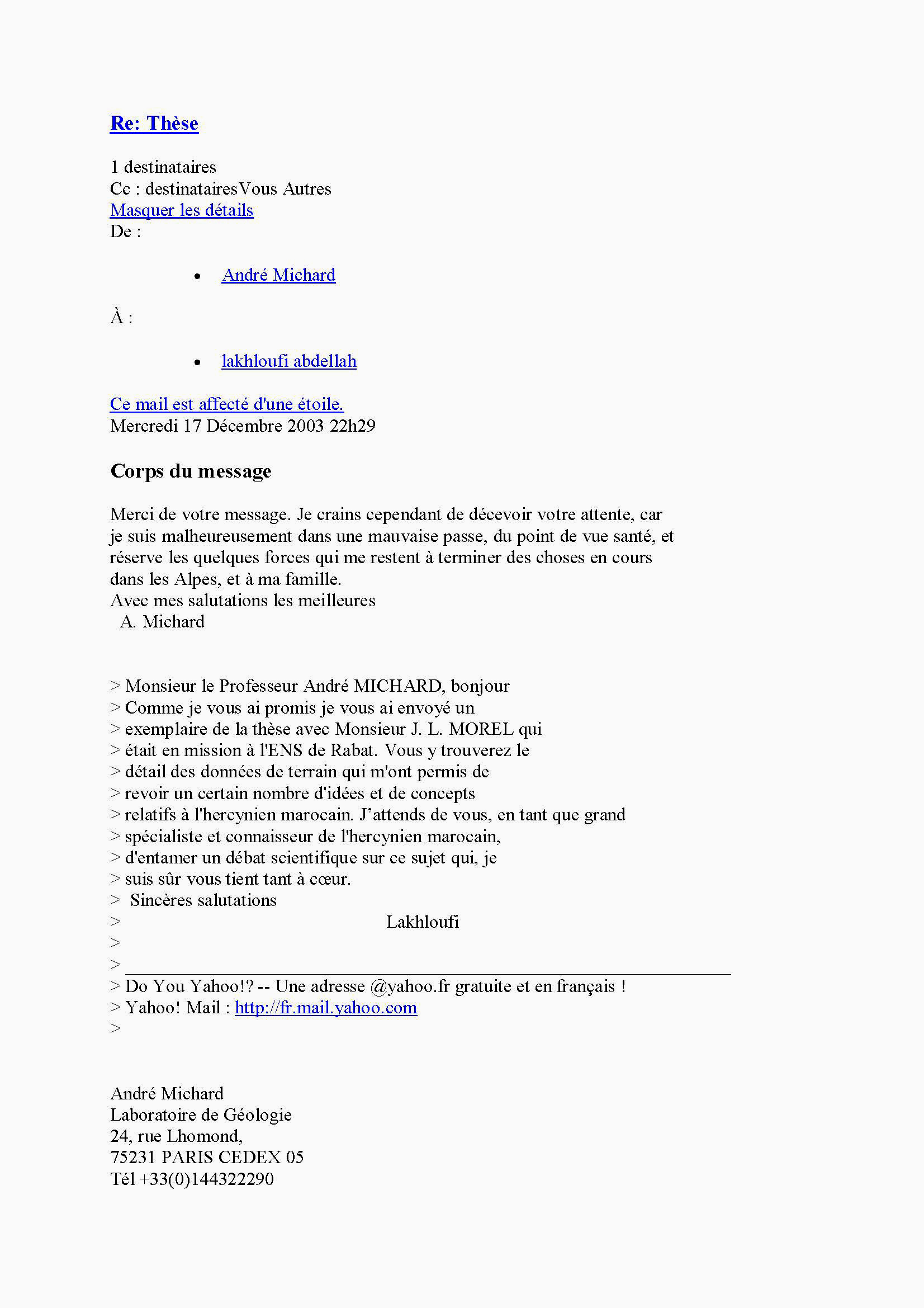
Here is the correspondence by email between me and Prof. Michard, after having sent him a copy of the thesis and an electronic copy on CD, with Prof. Jean Luc Morel from the University of Paris VI.
xxxxxxxxxxxxxxxxxxxxxxxxxxxxxxxxxxxxxxxxxxxxxxxxxxxxxxxxxxxxxxxxxx
Re: Thèse
1 destinataires
Cc : destinataires Vous Autres
De :
À :
Ce mail est affecté d’une étoile.
Mercredi 17 Décembre 2003 22h29
Corps du message
Merci de votre message. Je crains cependant de décevoir votre attente, car
je suis malheureusement dans une mauvaise passe, du point de vue santé, et
réserve les quelques forces qui me restent à terminer des choses en cours
dans les Alpes, et à ma famille.
Avec mes salutations les meilleures
A. Michard
> Professor André MICHARD, hello > As I promised you, I sent you a copy of the thesis with Mr. J. L. MOREL who was on mission at the ENS in Rabat. You will find there the details of the field data which allowed me to review a certain number of ideas and concepts relating to the Moroccan Hercynian. I expect you, as a great specialist and connoisseur of the Moroccan Hercynian, to initiate a scientific debate on this subject which, I am sure, is so close to your heart. > Sincerely, > A. Lakhloufi
André Michard
Laboratoire de Géologie
24, rue Lhomond,
75231 PARIS CEDEX 05
Tél +33(0)144322290
Xxxxxxxxxxxxxxxxxxxxxxxxxxxxxxxxxxxxxxxxxxxxxxxxxxxxxxxxxxxxxxxxxxxxxxxxxxx
So, towards the end of 2003, Professor Michard replied to me that he "reserves the few strengths that remain to him to finish things in progress in the Alps ...", and, consequently, he could not not respect its commitment for a scientific "debate", following our discussion of El Jadida, about a year ago. Nevertheless, several years later, in 2008, Prof. Michard, as principal editor (in coordination with professors Omar Saddiqi, Ahmed Chalouan and Dominique Frizon de Lamotte, as co-editors) published a textbook on Moroccan geology in the Springer edition, under the title:
« Continental Evolution: The Geology of MoroccoStructure, Stratigraphy, and Tectonicsof the Africa-Atlantic-MediterraneanTriple Junction»
Then, in 2010, as lead author (with several co-signatories), Prof. Michard published an article in the Elsevier Journal under the title: "The South-Western Branch of the Variscan Belt: Evidence from Morocco"
I'm happy for Prof. Michard, it feels good anyway, after all, he's still active ..., nevertheless, what is distressing, if not incomprehensible, is that the work of Prof. Lakhloufi, relating to the Moroccan Hercynian (new scientific data, at all scales of observation) have been deliberately ignored and glossed over ... So what Prof. Michard said in the introduction to his book (Michard et al. 2008) "the large number of references offering a comprehensive review and insight into the geology of Morocco" (cf. below,) does not really offer a review and a complete overview of the Moroccan Hercynian… indeed, the Moroccan Hercynian remains to be reviewed after my work in the key region which is the NW of the western Meseta. Let's see what Prof. Michard wrote in the introduction to his 2008 book on Moroccan geology:
"" This new book provides an updated overview of the geological knowledge of Morocco based on the achievements of the last few decades. The authors pay homage to their predecessor’s work with a large set of references providing a complete review and insight into the geology of Morocco. After an outline of the geological structure and evolution of the country, in the context of the African continent and peri-Atlantic plate tectonics, the book considers successively the Pan-African Belt with a refined geodynamic interpretation; the Variscan events in the Anti-Atlas and southern Morocco as well as in the Meseta Domain; the Atlas System, Rif Belt, Atlantic Basins and Mesetan and Saharan Plateaus, all of which developed during the Alpine cycle; and finally the Quaternary deposits."""
NOTE: I think Prof. Michard was unable to position my work temporarily and spatially; is it with the predecessors or the successors and, is it in Morocco or elsewhere? Or it has nothing to do with the Moroccan Hercynian, as he sees it!!! I think that's why he didn't talk about my work
This is, of course, a serious ethical problem; It is incomprehensible and totally unacceptable that such actions emanate from a distinguished professor and scientific researcher ... who is called upon to transcend such behavior ... in my opinion, it does not suit him at all.
Now let's look at other aspects of the scientific blockade.
B - Attempt to block the publication of my articles in Spain
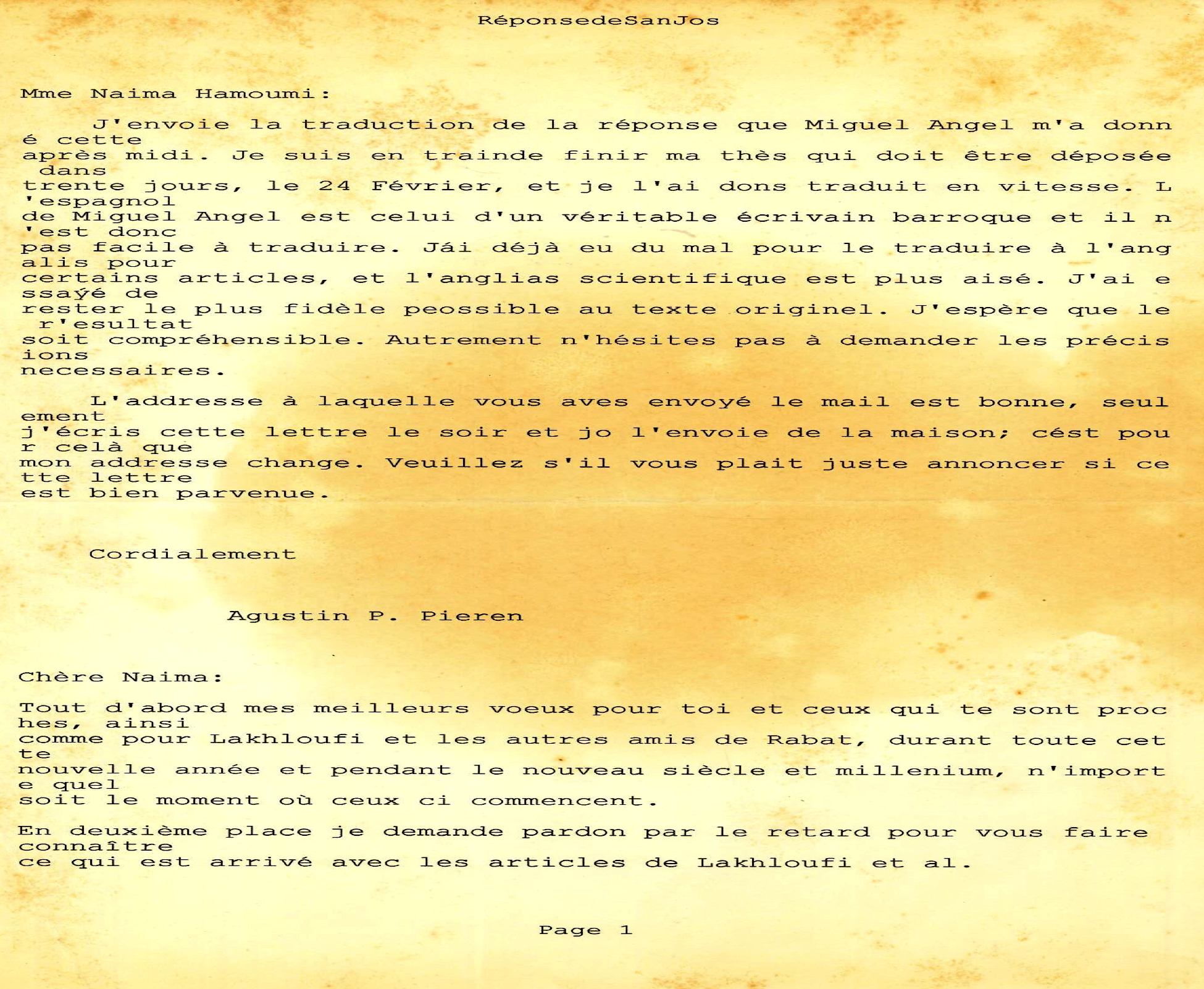
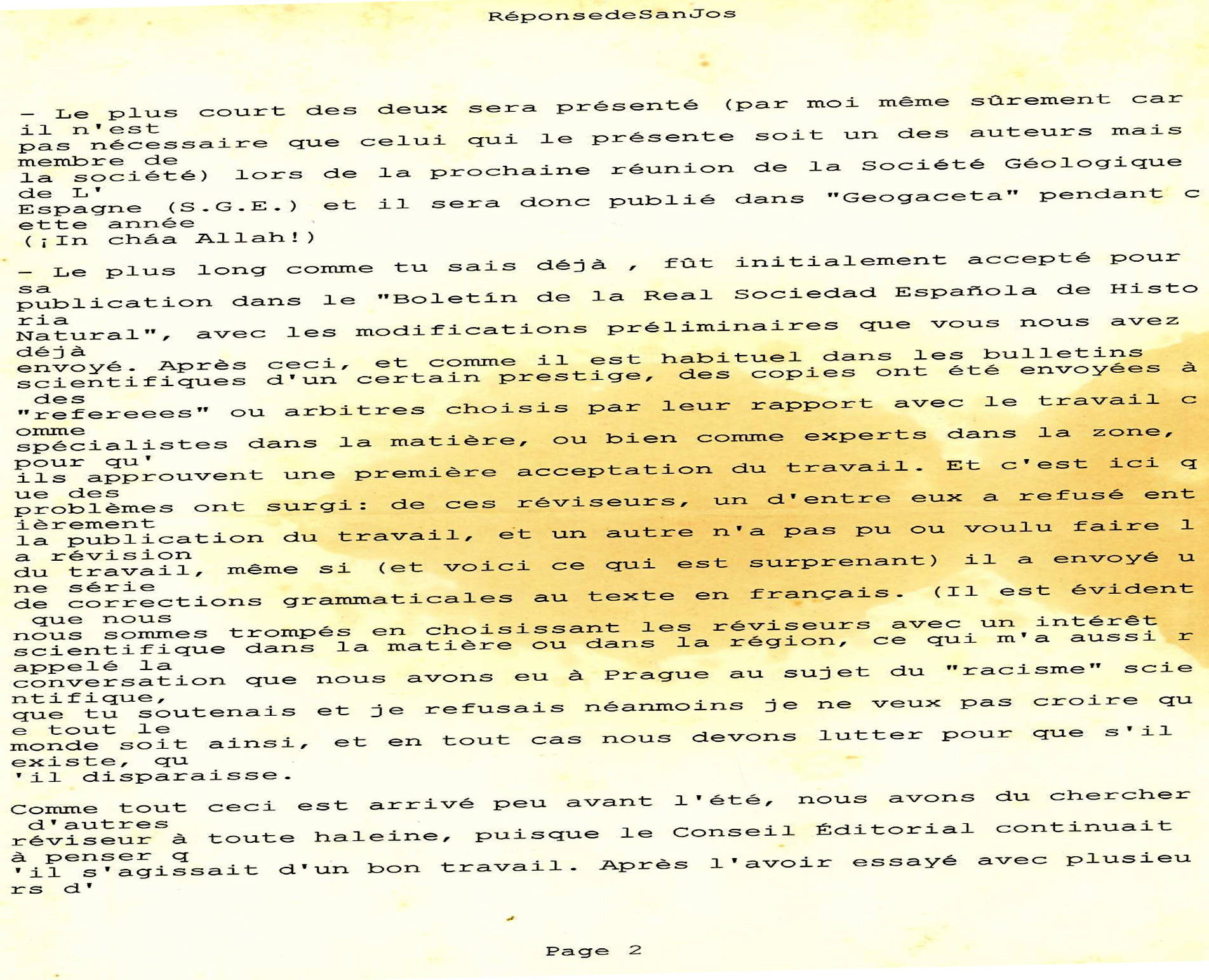
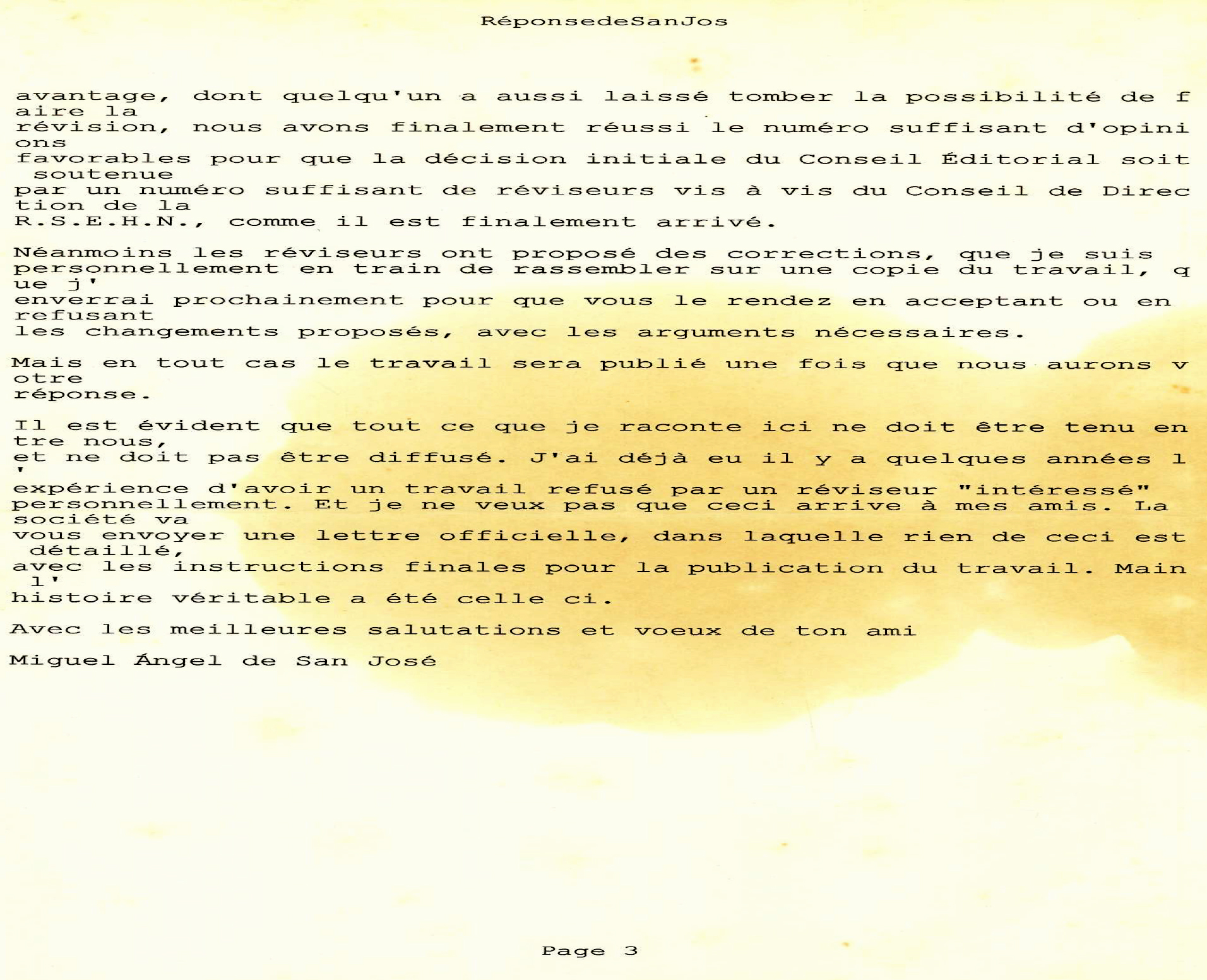
Without going into all the details, one of my articles, which was not accepted for publication in the journal CRAS (Compte Rendu de l’Académie des Sciences)…, was sent to Spain for publication in “Boletin de la Real Sociedad Espanola de Historia Natural ”(RSEHN), where the editorial staff of the journal gave its favorable opinion for the publication of the article, even before the opinion of the reviewers. However, in addition to the Spanish reviewers, the staff saw fit to also send this article to two French reviewers, given its scientific interest and originality. There the scientific credibility of the French examiners was severely tested (see supporting document, attached). Indeed, one of the French reviewers "categorically refused the publication of the work", while the other "did not want to review it, although he sent grammatical corrections of the text in French". Professor Miguel Angel De San José, of the Co plutense University of Madrid, who was amazed at such behavior by these French scientists, wrote to Pr. Naima Hammoumi ("administrative" director of my thesis) of the University Mohamed V from Rabat to tell him: "it is obvious that we made a mistake in choosing reviewers who have a scientific interest in this region, which reminded me of the conversation we had in Prague about" racism " scientist that you supported and that I refused; nevertheless I do not want to believe that everyone is like this, and in any case, we must fight for it to disappear, if it exists ".
C - Findings and testimonies
It is truly unfortunate, if not very disappointing, that scientific researchers, sometimes eminent professors, can descend so low on the "international" scale of scientific ethics. These are, in (A) and (B), two well-argued cases (as illustrated examples), which show the "state of siege" imposed on my work, relating to the Moroccan Hercynian, by certain French geologists. who I think firmly believe that they are the master godfathers of Moroccan Hercynian geology. It's unfortunate, but this is the reality, this is the truth ...
Nevertheless, I recognize that it was, mainly, the French academics who taught me geology, during my university studies (as I specified before) and who supervised the work of my postgraduate thesis at the Higher Normal School Souissi (Rabat). On this occasion, I pay a great tribute to the great man, Professor Henri Gonord, who introduced me to research in structural geology, and as supervisor of the 3rd cycle thesis ... he is a great man of a special character
On the other hand, there is another aspect of the state of siege which is the ignorance of sending my articles to scientific journals for publication. Often times, I don't get any response about sending an article; thus, neither seen nor heard. In short, I think that there is sufficient evidence to confront the scientific community with this bitter reality which does not honor scientists and, which harms Science and scientists; scientists who must transcend such pettiness.
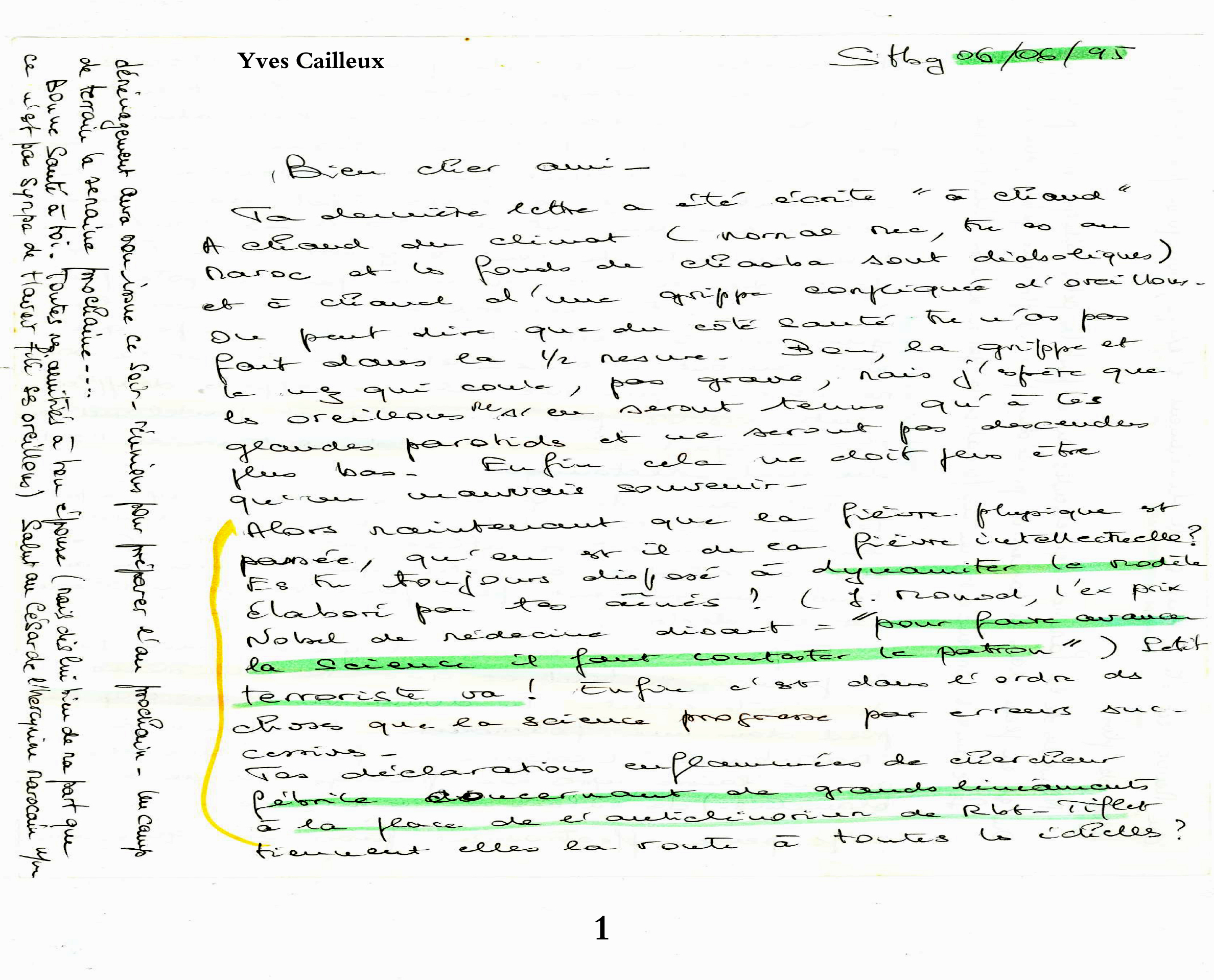
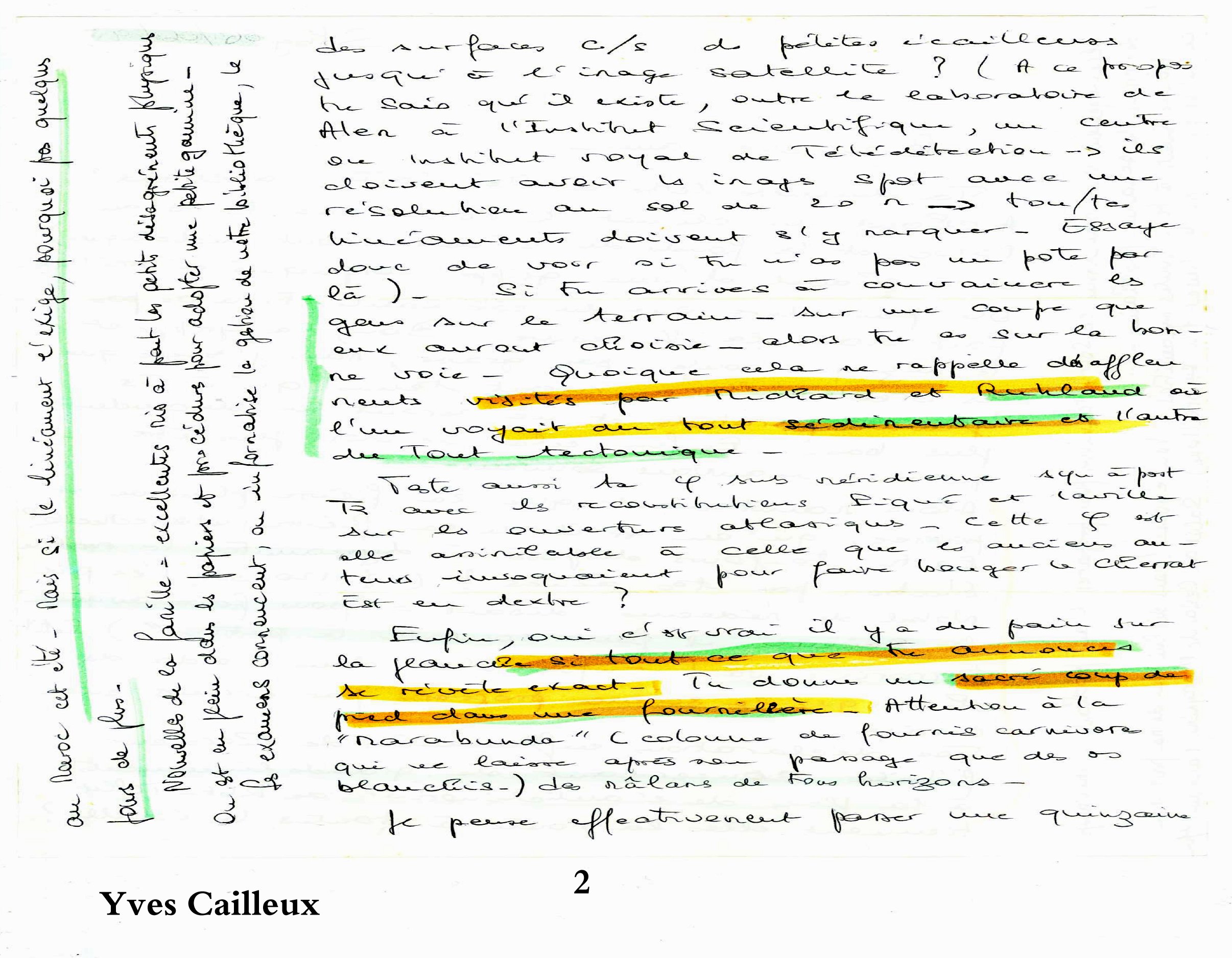
As my friend Cailleux told me (in a letter of 6/6/1995, when I let him know that there is no chaotic formation between Rabat and Tiflet south of the Sehoul Block, but a terrible shear zone): "" "Are you still willing to dynamite the model developed by your elders? (J. Monod, the former Nobel Prize winner in medicine said “to advance science we must challenge the boss.” Finally, it is in the order of things that science progresses by successive errors. ”In the back of the letter he wrote: “… Although it reminds me of outcrops visited by Michard and Ruhland where one saw at all sedimentary and the other at all tectonic.” A little further down he wrote: “Well, yes, it is true, there is work to be done if everything you advance turns out to be correct - You give a hell of a kick in an anthill - Be careful where the "Marabunda" (column of carnivorous ants which leaves only bones after its passage whitened) moans from all walks of life - »» »(cf. letter).
Of course, none of what Cailleux expected happened; the detailed argumentation of the shear zone as well as the argumentation in favor of the absence of the famous chaotic formation (see thesis and “Notes et Memoires”) nailed the beaks, so there only remained to these scientists, as a reply, than to say "move around, we haven't seen or heard anything".
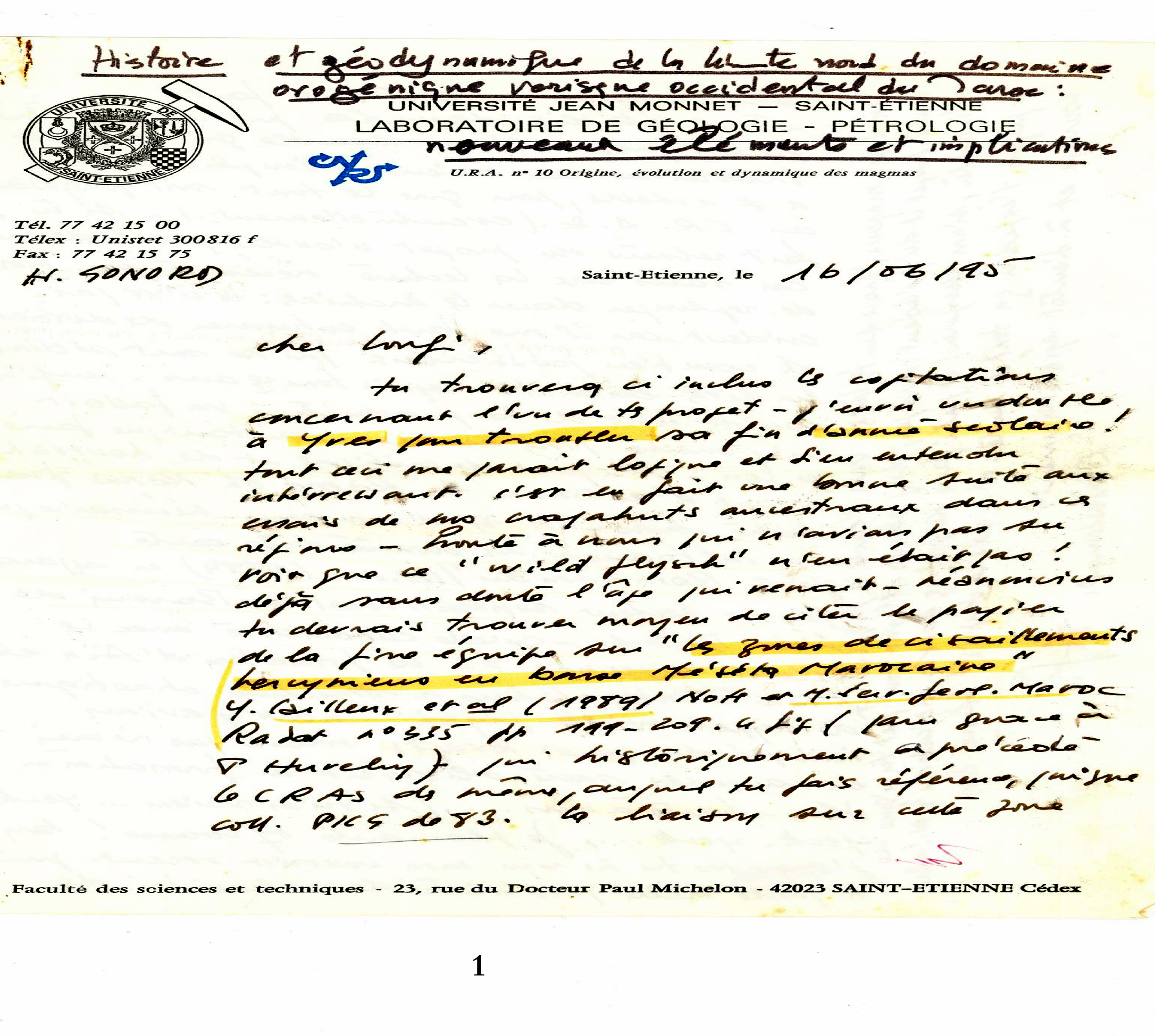
Regarding the existence of a rocky chaos of a tectonic nature, in a major shear zone and not of a chaotic formation of Famenno-Tournaisian age, Professor Henri Gonord (my supervisor in postgraduate thesis) told me had written (letter of 19/6/1996; see attached): “… shame on us who did not know how to see that this“ wild flysch ”was not…”. In another paragraph, of the same letter, he wrote: “The Formation of Ain el Klab with intercalations of chaotic structure of the 'wildflysch' type. We have indicated crushed areas but not questioned these sacred olistolites or block formation - shame on us ...
So there you have it, I have decided to share with the scientific community the results of my research work in the NW of the western Meseta, a key area for understanding the Moroccan Hercynian, for any useful scientific purpose; original scientific data. As I have shared with you, too, this is the ethics of scientists, which has been seriously flouted by those who were to honor it. What do you think? The ball is yours; It's your turn... I think we have to fight against "scientific racism", as Professor Miguel Angel of San José wrote in his letter (attached).
D -Original geological data that we do not want the scientific community to know
Below are several important new structural data that go against pre-established ideas (previous work) concerning the Moroccan Hercynian (see my thesis on the website):
1 - The Sidi Bettache Basin (BSB) (Piqué, 1979) actually corresponds to two contiguous basins, distinct in space and time (see my thesis): - the Sidi Bettache Basin meaning strict (BSB s.s), in the West, open from Upper Famenian to Lower Visean; opened by E-W extension; - the Brachwa - Maaziz Basin (BMB) in the East, opened to Middle Visean by N-S extension.
2 - Basic magmatism is not dependent on the edges of the BSB (Piqué, 1979), it is, in fact, exclusively limited to the BSB s.s, where it generally marks out submeridian faults, in particular those NNW-SSE.
3 - Two major phases of deformation, of post-visean - ante-permian age, affect the land in the region; the first phase generated ENE - WSW P1folds, and the second phase generated NNW - SSE P2 folds. A third Permian age phase generated P3 folds, locally well expressed at the BSB s.s. The first phase of folding is well expressed in the BBM, while the second phase is well expressed in the BSB s.s, and it is the only deformation phase that has affected the Coastal Mole.
4 –The verging of tectonic structures (faults and folds), due to the first phase of deformation, is towards the north, not towards the south as claimed by Pique (1979); therefore, it was not the Sehoul Bloc that punched the BSB (Piqué, 1979) from the north, on the contrary, it was the Zaer - Oulmès Bloc that “punched” it from the south.
5 - Highlighting of a major shear zone constituting the northern limit of the Hercynian Mesetian domain (North Mesetian Shear Zonee), the width of which can reach 4 (four) kilometers, where the magmatic rocks (basalts of the Ordovician; granites of the Upper Proterozoic and Upper Devonian and others which are not yet dated) and sedimentary, the age of which extends from the Cambrian to the Visean (Carboniferous), constitute a tectonic chaos that has been ( and still is) considered as a chaotic formation of Famenno -Tournaisian age (Piqué, 1979; El Hassani, 1990; Michard et al., 2010; Tahiri et al. 2010).
6 - The major overlap of the Sehoul Block to the south took place in the Upper Devonian, during the opening of the BSB s.s, not after the Visean as claimed by Pique (1979); the BBM will not open until later, during the Middle Visean, after rotation of the tectonic stresses..
7 - The coastal Meseta (Mole), as well as a wide band to the east (including the BBS ss, the Rehamna and the central Jbilet, the western High Atlas, the western Anti Atlas, including the Anti-Atlas allochthonous) show structural features of submeridian direction (notably NNW - SSE); while in the rest of the mesetian and anti-atlasic domains towards the east, the sub E-W structural directions prevail.
NOTE, stand-by:
The anticlinal fold that Piqué (1979) described in his thesis, and which served as an argument in favor of the verging towards the south of the tectonic structures in the BSB (between the Sehoul Block in the north and the Zaer - Oulmès Block in the south) has disappeared. The southern limb of this fold, which he described (in x = 392.2; y = 349.3), on the western side of the Wadi Grou valley, on the northern edge of the Brachwa runway ( between Brachwa in the West and Moulay Idriss, in the East) was removed during maintenance work. However, this plurimetric fold is found on the southern flank of a map-scale anticline (Anticline of Gait Al Kelb) inclined to the north (north flank is subvertical, while the southern flank has a medium to shallow dip, with structural “ledges” which cause a local tabular aspect) (cf. thesis).
E - LAST EPISODES OF THE SHEET:
After his retirement, I met Mr. Cailleux in Morocco, and during our discussion, I told him, reminding him of his letter that "the carnivorous ants" did not even show up when I "gave a kick in the anthill… ”(see letter), they quite simply decided to ignore me completely and boycott me. My friend Cailleux then answered me, among other things: "... yes, they will not accept easily ... especially that self-love comes into play ...".
Yes, this is the story of the self-esteem of the great masters !!! Goodbye science. Who are you, you who dare to demolish the buildings of the great masters? Although it’s about science. I didn't try to demolish their building by building mine. Besides, I was open to everyone, I held out my hand to them, but in vain. I had no problem with Professor Michard, for example, being the first author of an article, for example the one concerning the North Mesetian Shear Zone; Moreover, that is why I sent him the thesis, proposing a revision of the data concerning the Moroccan Hercynian domain (see above). There is also Prof. Christian Hoepffner, from the Faculty of Sciences of the Mohamed V University of Rabat, to whom I extended my hand, offering him to be the director of my state thesis and, I offered him a field in the extreme east of Morocco, in the region of Talsint - Bou Arfa - Figuig, far from the regions where they do not want me to work there (far from the north western Meseta where my postgraduate thesis represented a task of oil which will spread to the whole of the Hercynian area west of Mes Maintain), but he diplomatically dodged my request. Without forgetting also Professors Tahiri and El Hassani of the Scientific Institute, Fadli and Zahraoui of the Faculty of Sciences… They never wanted to speak to me directly and frankly, they made me pass their "requests" via Yves Cailleux (before 'he leaves for France) and, when I wanted to speak to them directly, Mr Tahiri, for example, always found a way to tell me that there is no problem with me!... no problem between us Moroccans!
Other scenes from this serial concern my communications at symposia and congresses; French and Moroccan hercynologists (who belong to the French Hercynian Geological School) always act as follows: either they leave the place of the presentation before the start of the communication; or they stay in place, but neither seen nor heard, it's like I said nothing ... long live science ... great tribute, or rather a pity to the scientific spirit !!!!!
In short, these were a few flashbacks of a whole disappointing serial that does not honor the scientific community, in particular the French geologists. As I said above, it was the French teachers who taught me geology, so, in principle, I am their disciple, so they should be proud that they have been able to train competent geological researchers. But, if they think that I said anything in my thesis, they just have to demolish me at international scientific meetings, so that I disappear and never participate in these meetings.
I really liked that the opportunity presented itself to me to pay tribute to the French hercynological geologists [of course I pay tribute to Prof. Henri Gonord, responsible for the training of DEA (“Diplôme des Etudes Approfondies” from the past and my supervisor of the postgraduate thesis (also from the past), at ENS Souissi - Rabat; as I also pay tribute to my friend Yves Cailleux who shared my scientific concerns and all my worries with me], but unfortunately, they missed the boat, as we say; quite simply they behaved badly.
The best for the end (excerpt from the foreword about the thesis)
By way of conclusion, I reserve a special place for those on the other side of the Strait from Jabel Tarik (Gibraltar) who has made a decisive contribution to the final outcome of this work. Before talking about people, I would first like to pay a vibrant tribute to the Spanish geological journals which have distinguished themselves by a flawless morality, based on respect for human and scientific values. At a time when scientific journals elsewhere did not even bother to inform me of the receipt of the articles that were sent to them or did not follow up on the first response - when they happened to them to inform me - Spanish journals have shone by the scrupulous respect for the rules of the game required by scientific duty; science is universal. This is an attitude that does honor to the scientific community in general and to Spain in particular. As for the people who are an integral part of the circle of those who have helped in the development and the culmination of this work, I begin with Prof. Miguel Angel DE SAN JOSE, of the University of Complutense of Madrid, let him know that I find myself unable to express my deep appreciation to him for all he has done. The doctor Augustin P. PIEREN gave me precious moments to do things that only a true friend could do. I can't found the right words to thank him so much. I am simply saying that if the scientific community had to deal with such people, the notion of borders is reabsorbed and only the human dimension of relations is then a daily motto.
APPENDIX
Some pieces of evidence
for
scientific blockade
A/ Miguel Angel de San José
1- The article received the green light from the publishing staff
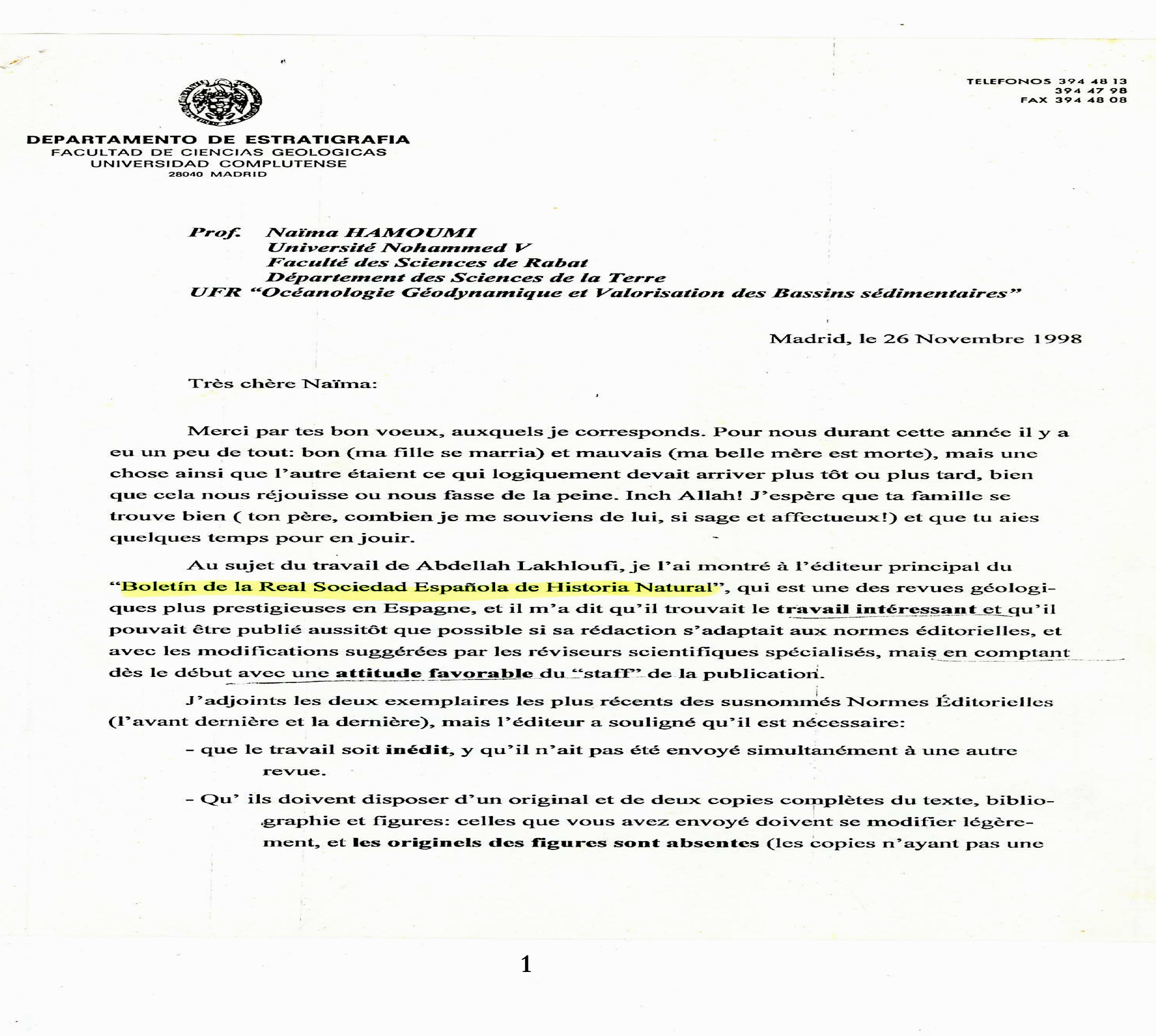
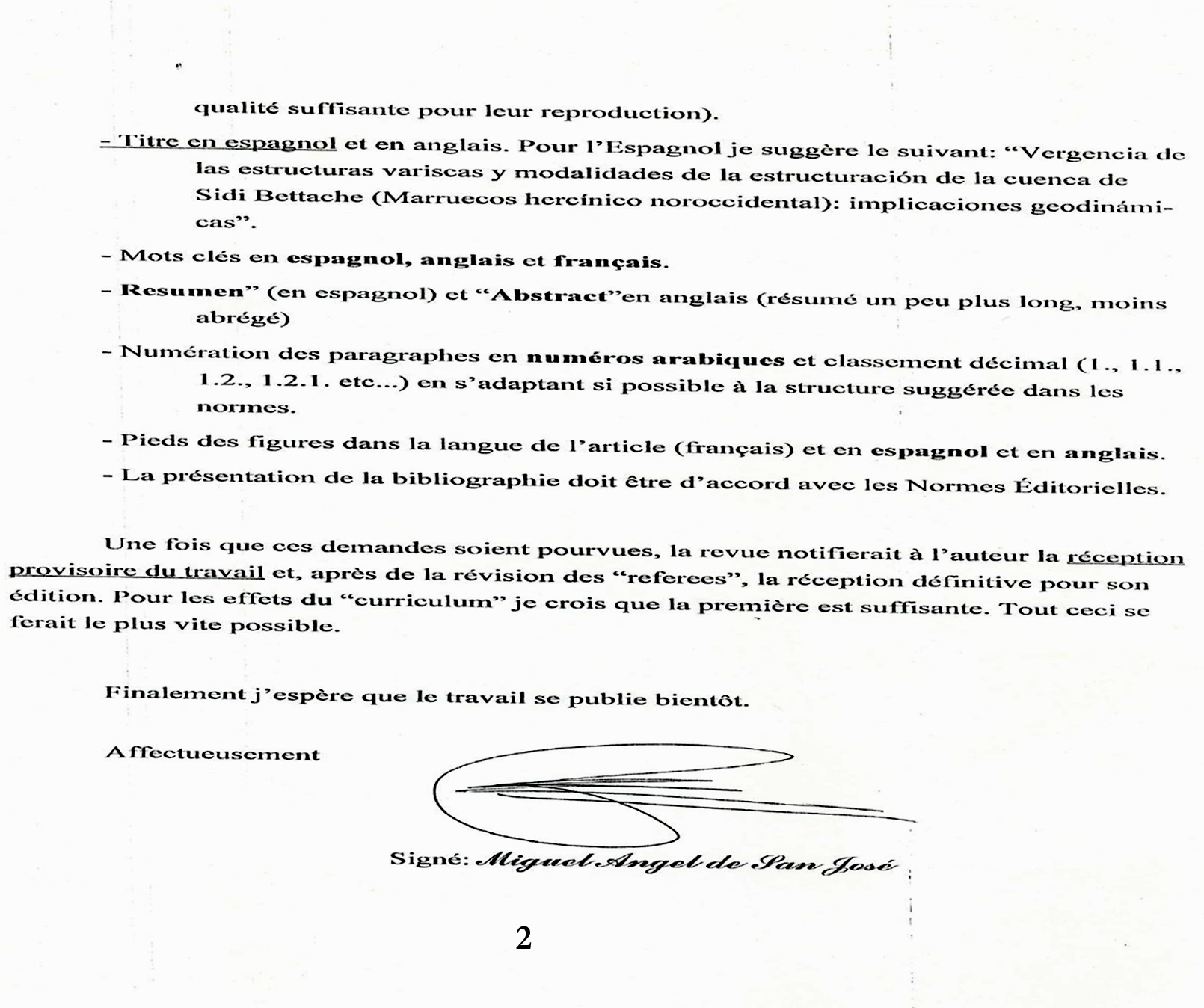
2 – The article is refused by French reviewers without reading
B- Correspondence with André Michard for a scientific discussion
C- Yves Cailleux wrote about the NMSZ
D- Henri Gonord wrote about the NMSZ
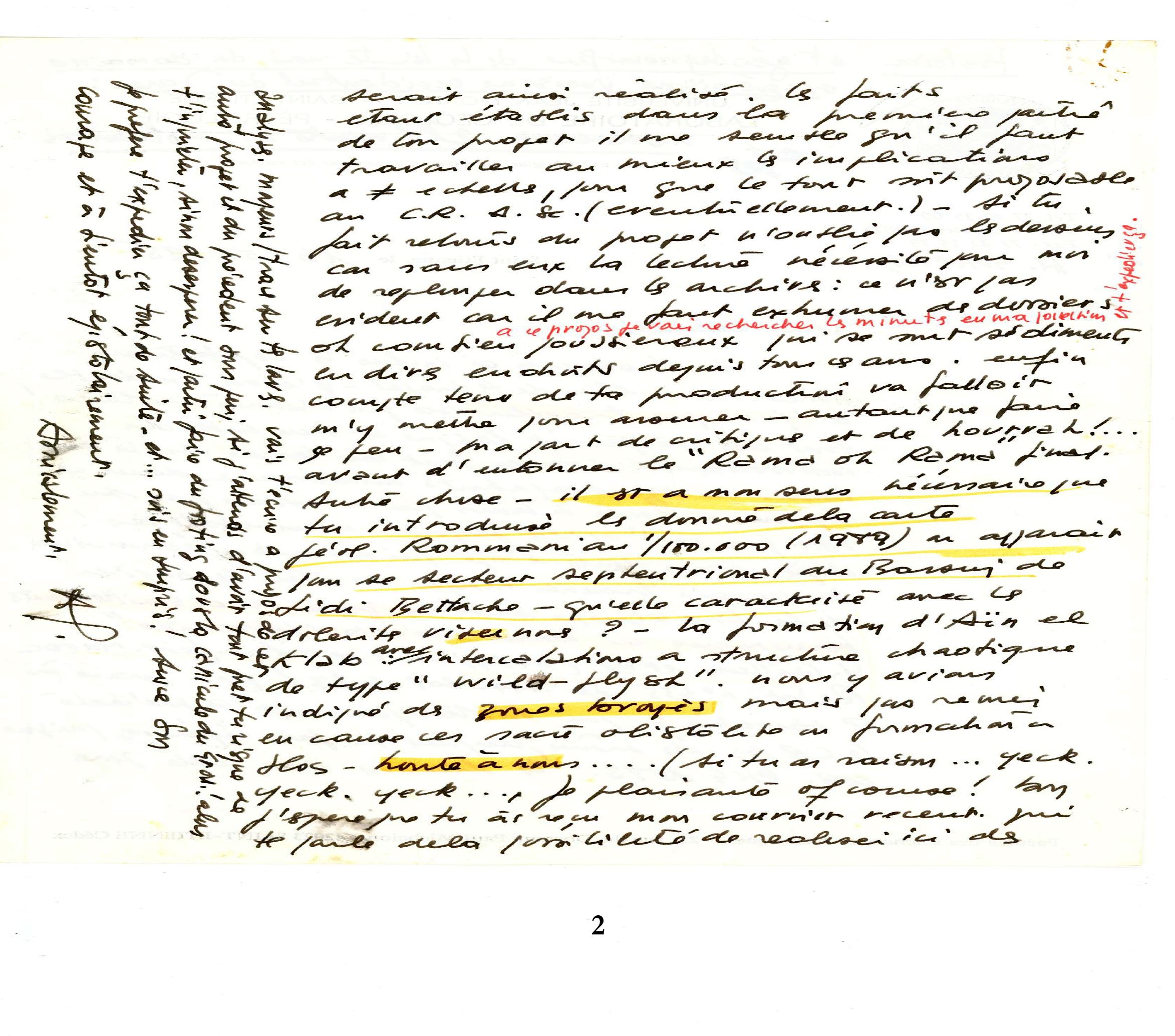
E - The real scientific blockade
It consists in the total boycott of my work; I am not cited anywhere in the bibliographic lists of books, journals and scientific articles. However, some of my data are used without giving any reference, such as the overlap (or thrust?) of the "Sehoul Block" to the south at the end of the Devonian.
You can check it out for yourself